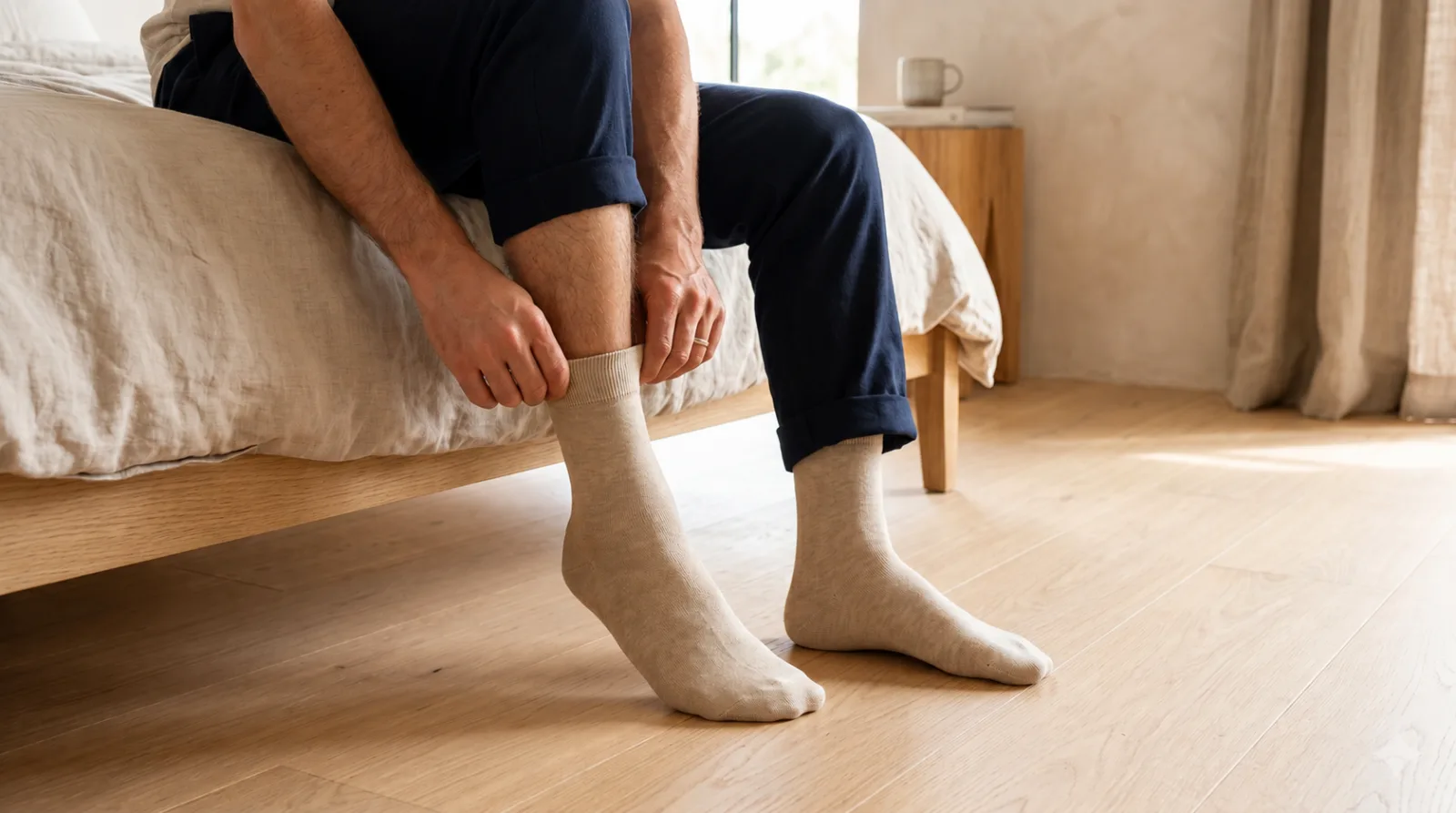
Bamboo sock types we manufacture
- Everyday crew and ankle socks. The volume sellers in most bamboo lines. The soft handfeel is the product story, so these are usually kept clean and minimal in design.
- Dress socks. Fine-gauge knits where bamboo viscose earns its place: a thin profile, a slight natural sheen, and breathability through a full office day. A common private label request from menswear and workwear brands.
- No-show and summer socks. Bamboo's moisture behavior suits warm-weather wear. Paired with a heel gripper so the no-show stays put.
- Comfort styles. Bamboo works well with the non-binding, seamless construction of our diabetic-style comfort range, and many comfort lines run bamboo as their lead yarn.
- Gift and subscription sets. Multi-pair boxes where the consistent, elevated handfeel across every pair is the reason customers renew.
What bamboo viscose actually is
Honesty serves this category better than hype, so here is the plain version. Bamboo socks are knit from bamboo viscose: cellulose from the bamboo plant, dissolved and regenerated into a smooth fiber. The bamboo plant itself grows quickly and densely without irrigation or replanting, which is the genuine part of the sustainability story. The viscose process, however, is a chemical one, which is why we describe this yarn as bamboo viscose rather than calling the sock a natural product outright.
What the fiber indisputably delivers is feel: a smooth, cool, almost silky hand that customers notice immediately, strong breathability, and natural moisture management. We specify every yarn by exact composition, and when your brand's positioning requires a specific certified yarn, you supply the certification requirement and we source against it.
Construction options in detail
Bamboo viscose is a softness yarn, not a structure yarn, so construction choices do the durability work:
- Blended body. Combed cotton or polyamide alongside the bamboo keeps the sock's shape and multiplies its life. Elastane holds the fit.
- Reinforced heel and toe. Polyamide plated into the wear zones, invisible from outside, so the softest part of the sock isn't also the weakest.
- Seamless machine-linked toe. Standard on our bamboo range. A rough toe seam would undo exactly the smoothness the customer paid for.
- Cushioning where wanted. Terry soles for comfort lines. Flat fine knits for dress. Both run from the same yarn shelf.
- Cuff options. Ribbed for everyday, flat welt for dress, and a relaxed comfort top where the line calls for it.
How bamboo socks are made
Production follows the standard sequence, knit, close, board, inspect, described step by step in our how socks are made guide. Two notes specific to this yarn: bamboo viscose takes dye richly, which is why bamboo ranges photograph with deep, saturated colors, and its softness demands careful tension calibration on the machine, one more reason sampling exists. At inspection we check handfeel consistency across the batch alongside the usual sizing and pattern checks, because feel is the promise this category makes.
Typical blends and labelling
A pure bamboo sock would lose its shape within weeks, so honest bamboo socks are blends. Typical recipes: a bamboo-majority blend with polyamide and elastane for everyday ranges, or bamboo with combed cotton for a natural-fiber story with more structure. The exact ratio is a decision we make together at sampling, balancing feel, durability, and price, and it's documented in the tech pack so your labels and listings state the true composition. That documentation is also your protection: "bamboo" socks with undisclosed majority-polyester blends are common in the market, and specification is how your brand avoids being lumped in with them.
Private label programs, MOQ, and ordering
Bamboo lines are usually private label: your brand on the sock, the label, and the packaging. Typical buyers are eco-minded labels, comfort and everyday brands, gift and subscription businesses, and retailers adding a soft premium tier. The minimum is 50 pairs per design and size. A first range of two styles in three sizes lands around 300 pairs, and the counting logic is in our MOQ guide. Gift sets are worth planning early because the box does much of the selling. Options are compared in our packaging guide. From brief to delivery: a quote within 24 hours, a physical sample to approve, then 3 to 6 weeks of production.
Why brands knit bamboo with us
Because the category runs on trust in the label, and we build the sock to match it: compositions documented exactly, certified yarn sourced when your spec requires it, machine-linked toes in-house, every pair pre-washed for a soft first touch, and a 50-pair minimum that lets you test a bamboo tier without committing a season's budget. Production runs on our own 26-machine floor in Istanbul, and ships worldwide on DAP or FOB terms.