Running sock types we manufacture
A running range is usually a family of heights and weights built on one fit philosophy. The styles brands order most:
- No-show and invisible socks. The racing and summer cut. Held in place by a heel tab, an internal silicone gripper at the heel collar, and tuned cuff elastic, because a no-show that slips is the fastest one-star review in running.
- Ankle and quarter socks. The everyday training volume seller. Quarter height keeps the shoe collar off the ankle bone, which is why many brands make it the hero SKU.
- Crew running socks. The current retail default, worn visible. Crew height also gives the most canvas for knit-in branding and colorwork.
- Trail socks. Merino blends, denser cushioning, and reinforced wear zones for rock and grit. Usually the premium tier in a range.
- Event and finisher socks. Race merchandise knit in event colors with the year, distance, or finisher mark built into the fabric. Ordered by race organizers and run clubs on fixed event deadlines.
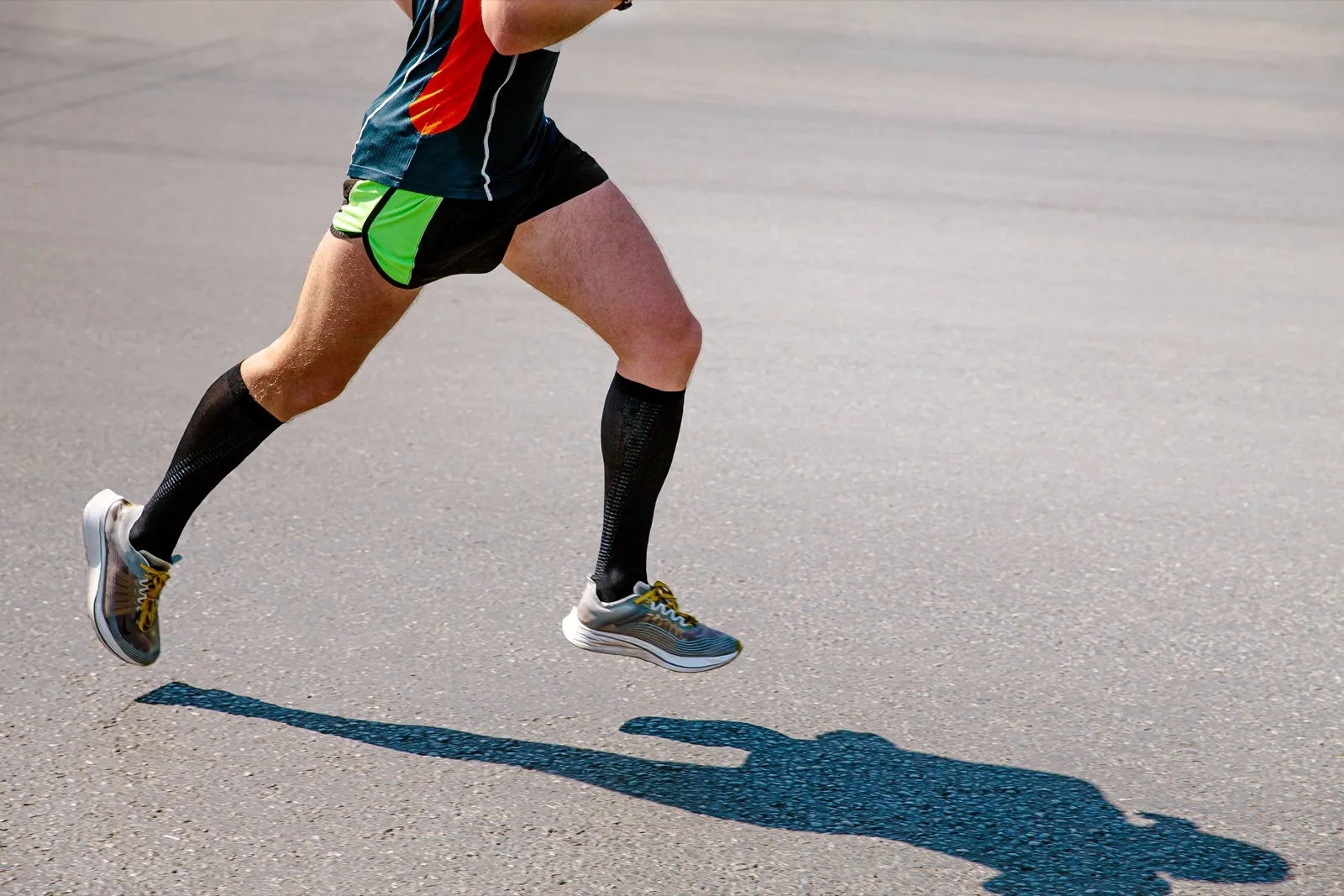
- Recovery styles. Firmer knit at the ankle easing up the leg for after-run wear. Detail on our compression sock manufacturing page.
Construction details that matter over distance
Runners feel construction decisions at kilometer thirty that nobody feels in a fitting room. These are the ones worth specifying deliberately:
- Targeted cushioning. Terry loops knit under the heel and forefoot, where impact lands, while the arch and instep stay thin for a close shoe fit. Loop density is a spec choice: race-thin, balanced trainer, or max-cushion recovery.
- Mesh ventilation. An open-structure panel over the instep vents heat where the foot runs hottest. Knit into the fabric, not cut and sewn.
- Seamless toe. Machine-linked closing leaves a flat join across the toes. Over distance, a raised seam becomes friction, and friction becomes a blister, so this is standard on every running sock we make.
- Arch band. A knit-in elastic band around the midfoot that keeps the sock from rotating as the foot flexes.
- Anatomical shaping. Left and right specific knitting follows the asymmetry of the foot, keeping the toe box aligned and eliminating loose fabric at the toes.
- Reinforced wear zones. Polyamide plated into the heel and toe multiplies abrasion life without changing how the sock feels elsewhere.
- Hold at the cuff. Heel tabs, silicone grippers, and cuff tension tuned to the height of the sock, so the fit survives the run, not just the first kilometer.
How running socks are knit
Performance socks are knit on fine-gauge circular machines, with the functional zones programmed into the pattern file: cushion loops here, mesh structure there, rib for the arch band, plated reinforcement at heel and toe. The technique that makes wicking work is plating, where two yarns are knit in one pass so the moisture-moving fiber sits against the skin while the structural yarn faces out. The full sequence from yarn cone to boarded pair is in our how socks are made guide.
At the sample stage we verify fit on foot, cushioning placement against the brief, and wash behavior, because a running sock is judged after its twentieth wash, not its first. Production then runs on the documented settings so every batch matches the approved sample.
Materials: what actually runs well
- Polyester microfiber. The workhorse running fiber: moves moisture, dries fast, holds color through repeated washing.
- Polyamide. Adds durability and a smooth hand, and does the reinforcement work in heels and toes.
- Merino blends. Temperature regulation for trail and winter running, and wool's natural resistance to odor on multi-day use. Blended with synthetics for durability.
- Bamboo viscose. A soft, breathable option for everyday trainers and lifestyle-leaning running lines.
- Elastane, used more than in casual socks. A higher percentage delivers the locked-down fit runners expect. The exact number is a fit decision we make together at sampling.
What we steer brands away from: cotton-heavy blends for distance running. Cotton holds moisture, and damp fabric plus friction is the blister formula. Cotton has its place in casual and lifestyle socks. For performance SKUs, wicking fibers earn their cost.
Club, race, and event programs
Event socks run on different logistics than retail SKUs. The design carries the event identity, the event date is immovable, and quantities are known in advance. We knit club colors to Pantone references, build logos and year marks into the fabric with jacquard, and pack either for goodie bags (polybag) or expo retail (hangtag or sleeve). Plan backwards from the event: sampling plus production means starting 8 to 10 weeks out is comfortable, and tighter timelines are a conversation to have at the quote stage, not after approval.
Private label programs, MOQ, and ordering
The minimum is 50 pairs per design and size, and the counting is per SKU: one design in three sizes is 150 pairs. Anatomical left-right construction doesn't change the math, since a pair is knit as a pair. Most running brands launch with one or two styles in three sizes and a couple of colorways, which lands between 300 and 600 pairs. The full counting logic is in our MOQ guide.
Every project starts with a brief and a quote within 24 hours, followed by a physical sample. A tip specific to this category: put your sample pairs on real feet for real distance before approving. Fit feedback from a 15-kilometer run is worth more than any amount of on-paper review, and we build sample time into the schedule for exactly that. Production is 3 to 6 weeks from approval, with packaging developed in parallel, compared option by option in our packaging guide. Starting from an idea instead of a tech pack? Our product development service handles the design work, including matching and improving on a benchmark sock you like.
Branding, colorways, and range planning
Running socks are worn visible, which makes them one of the better branding surfaces in apparel. Knit jacquard handles logos at the cuff, along the achilles, and across the footbed. The conventions runners recognize are a logo at the cuff or heel tab and a wordmark under the arch. Jacquard works best with clean marks in two to eight colors, and the trade-offs against embroidery and print are laid out in our logo techniques guide. On range structure, most successful running lines run one hero colorway that never changes plus seasonal accents, because the hero drives reorders while the seasonal colors drive newness. Pantone references and color batch tracking keep the hero colorway identical across production runs.
Recycled and lower-impact options
Recycled polyester blends are available and behave like their virgin equivalents in wicking and durability, and merino and bamboo viscose offer natural-fiber stories where the performance case supports them. We keep sustainability claims tied to the yarn spec: the tech pack states exactly which fibers are recycled and at what percentage, so anything printed on your packaging is backed by the documented composition rather than a vague label.
Why running brands work with us
Running socks punish inconsistency, and consistency is the boutique advantage: machine-linked toes done in-house, documented tech packs so a subscription brand's March drop matches its January drop, and a 50-pair minimum that lets a new running label test real production quality without warehouse risk. We run 26 knitting machines in Istanbul with 2.5M pairs of annual capacity, and ship worldwide on DAP or FOB terms.