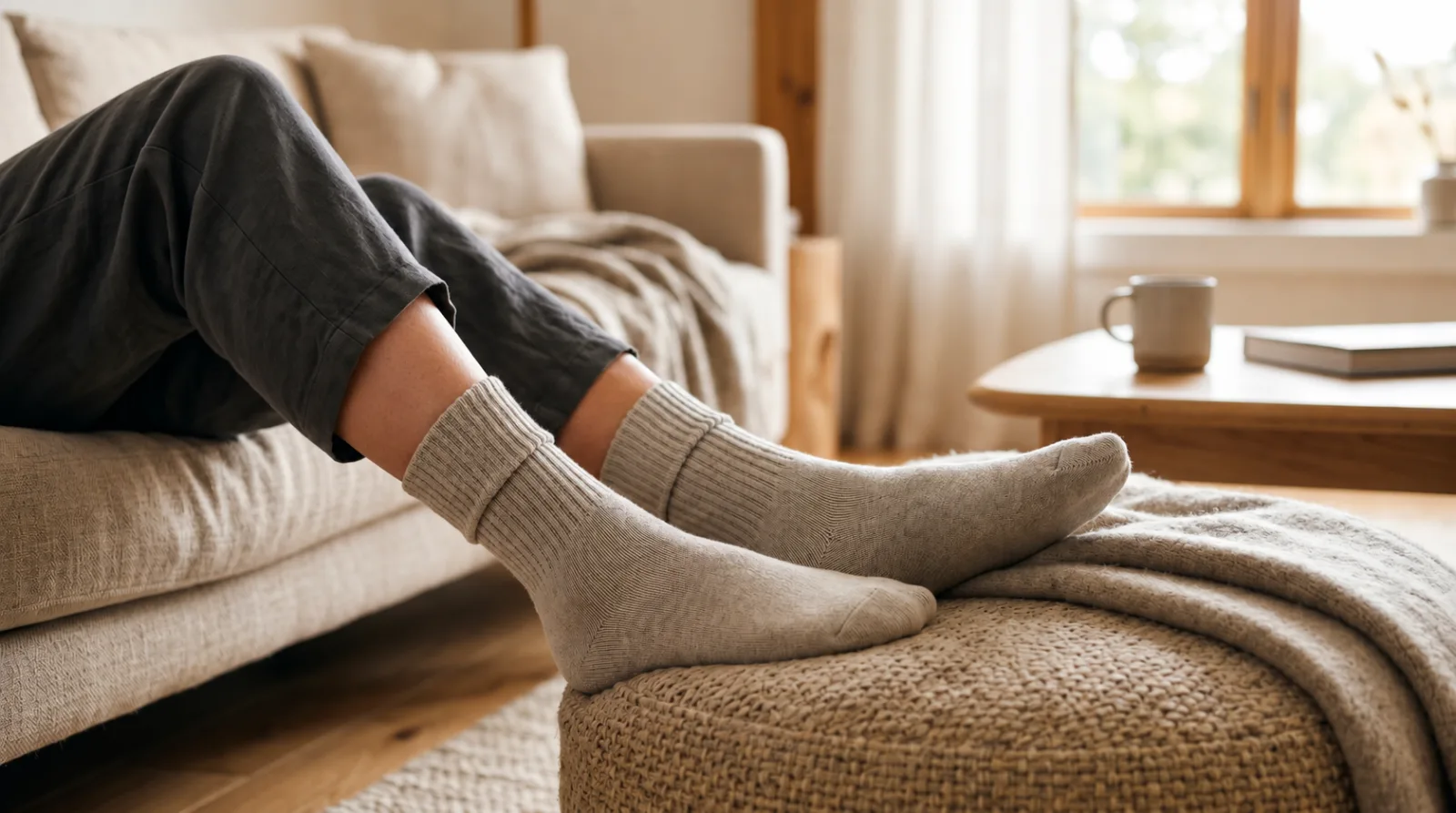
Diabetic-style sock types we manufacture
"Diabetic-style" is a construction category, not a single product. These are the variants brands typically build a range around:
- Crew comfort socks. The core SKU in most lines. Non-binding top, seamless toe, cushioned sole, in a calf-height cut that suits everyday wear.
- Quarter and ankle comfort socks. The same construction in shorter heights, usually paired with the crew in a multi-height range for warmer climates and summer assortments.
- Non-slip home and care socks. Cushioned comfort socks with silicone grip applied to the sole, built for home wear, hospital retail, and assisted living programs. Grip can be a dot pattern, full-sole coverage, or a logo shape.
- Wide-fit and extended-size styles. A wider last, a deeper and looser welt, and extended size runs for customers who find standard socks restrictive. Often the differentiating SKU in a senior care line.
- Dress-style comfort socks. Fine-gauge knits with the same non-binding and seamless construction in office-appropriate colors, a common request from pharmacy and menswear private labels.
White and light colorways remain the retail standard in this category, and we match any Pantone reference. Most programs run two to four of these styles as a coordinated range rather than a single SKU.
The construction details, one by one
Every feature that defines this category is a specific knitting or finishing decision. When you send a brief, these are the choices we're actually making:
- Non-binding top. The cuff is knit wider and deeper than a standard sock, with a relaxed elastane feed. The sock stays up by covering more leg with less tension instead of gripping a narrow band tightly. On the machine, that's a different welt structure, not just looser elastic.
- Seamless toe. We close the toe by machine linking: the open toe loops are joined loop by loop, leaving a flat join instead of the ridge a standard rosso seam leaves. It's a precision step, and it's the single feature wearers in this category notice most. Our guide to how socks are made shows where this step sits in production.
- Cushioned sole. Terry loops are knit under the foot for padding. Density is a spec decision: sole-only cushioning keeps the sock lighter, full-cushion construction adds padding over the instep for cold climates and home wear.
- Low-friction interior. The inside of the sock is finished flat and smooth, with no floating yarns or knots at pressure points. This is checked piece by piece during inspection.
- Gentle overall fit. The sock is knit on a wider fit standard with no tight zones from cuff to toe. Sizing is documented in the tech pack so refills and reorders fit identically.
How they're made, and what we inspect
Production follows the standard knit, close, board, inspect sequence, with settings chosen for softness: relaxed knitting tension, machine-linked closing as the default rather than the upgrade, pre-washing for a soft first touch, and boarding on wider forms so the finished sock holds its gentle fit.
Inspection in this category goes beyond the usual checks. Along with pattern and sizing, inspectors verify seam flatness at the toe, interior smoothness, and cuff recovery, because the whole value of the product is the absence of pressure points. A comfort sock with one hard seam is a failed comfort sock, whatever the label says.
Materials that suit diabetic-style socks
The yarn does half the work in this category. What we typically knit with, and why:
- Extra-soft combed cotton. The default body yarn: breathable, familiar to customers, and comfortable across seasons. Combing removes short fibers, which is what separates a soft hand feel from an average one.
- Bamboo viscose. Noticeably smooth and naturally moisture-wicking, popular with wellness brands positioning on softness. We also run it as the lead story in dedicated bamboo lines.
- Soft acrylic blends. Warm, light, easy-care, and gentle after repeated hot washes, which matters for care home laundry cycles.
- Merino blends. A premium option for temperature regulation in winter ranges.
- Elastane, used sparingly. A low percentage keeps the sock in place without creating the tightness the category is built to avoid.
Moisture management is a fiber property, not a marketing line: bamboo viscose and certain synthetics move moisture away from the skin and dry faster than untreated cotton. Antimicrobial-treated yarn is available on request and is specified as a yarn property in the tech pack. Every blend is documented by exact composition, so your labels and listings state precisely what the customer is wearing.
Private label programs, MOQ, and ordering
Most diabetic-style projects are private label: the sock, the packaging, and the size labelling all carry your brand. Typical buyers are pharmacy chains building a house comfort line, senior care and mobility brands, wellness DTC labels, and foot care companies extending into socks.
The minimum is 50 pairs per design and size. Because comfort lines usually run extended size ranges, plan the math per SKU: one style in four sizes is a 200-pair commitment. That is still small enough to test a range honestly. Our MOQ guide walks through how the counting works. A typical first program is two styles in three or four sizes, which lands between 300 and 400 pairs.
The process is the same as every Sokko project: send a brief and we return a quote within 24 hours, we knit a physical sample for approval, and bulk production runs 3 to 6 weeks from sign-off. Packaging is developed alongside the sock, and pharmacy programs usually take a printed box or sleeve with barcode placement to your retail spec. The options are compared in our packaging guide. If you're starting from an idea rather than a tech pack, our product development service covers the design work.
Fit, sizing, and planning a size run
Comfort lines carry wider size runs than fashion socks, because the buyer often shops by shoe size on a pharmacy shelf rather than trying anything on. A typical range runs four sizes, with wide-fit variants doubling the top sizes. Two planning notes from production experience: size splits are rarely equal, so weight the middle sizes in your first order rather than ordering flat across the run, and put the size marking somewhere the customer can read it on the shelf, on the sleeve or box rather than only knit into the sock. The fit standard itself, last width, welt depth, cuff tension, lives in the tech pack, which is what keeps a size Medium identical between your first order and your fifth.
Packaging, labelling, and shelf presentation
This category sells heavily through pharmacy and retail shelves, and the packaging does more work than in most sock categories. Printed boxes and sleeves carry the feature list where the buyer reads it, and multi-pair value packs, two or three pairs in one box, are standard because comfort sock customers replenish rather than collect. Composition labelling comes straight from the documented yarn spec, and barcode placement follows your retail requirements. We develop packaging alongside the sock so both arrive together, shelf-ready. The format options and their costs are compared in our packaging guide.
Why brands run this category with us
We describe this range as diabetic-style deliberately: what we manufacture is construction, and every feature on this page is a knitting, closing, or finishing decision we control on our own floor in Istanbul. Machine-linked toes are done in-house rather than outsourced, the 50-pair minimum makes a multi-size test range affordable, and reorders run from the documented tech pack so pair 5,000 matches pair 50. Three generations of textile work sit behind that consistency, and shipments leave Istanbul for the EU, UK, and US on DAP or FOB terms.