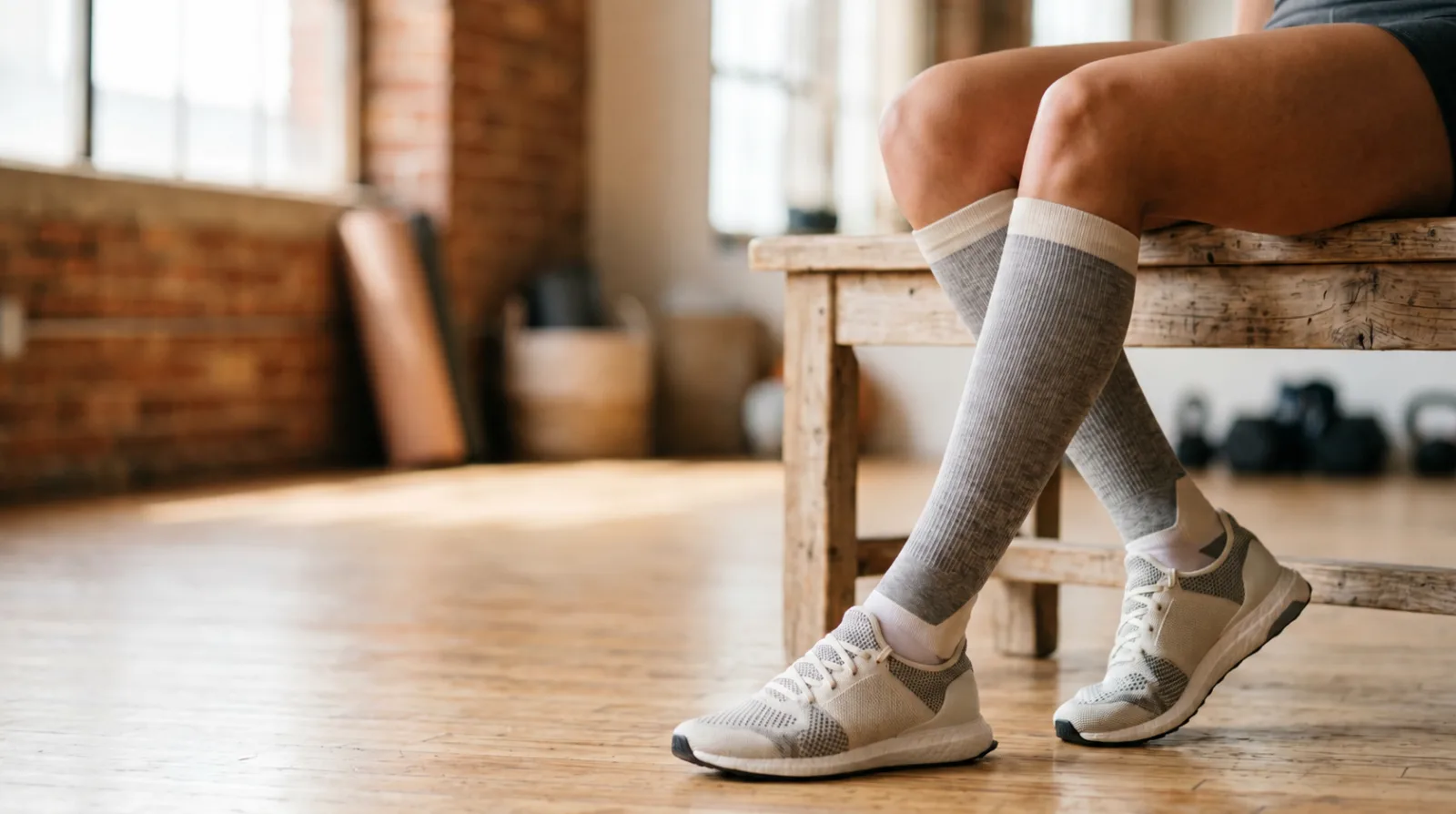
Compression sock types we manufacture
- Sport compression. Knee-high performance socks for running and cycling brands, usually with a firmer feel, footbed cushioning, and bold colorways that read at race distance.
- Recovery styles. Worn after training rather than during it, typically softer-feeling with a comfort-first yarn mix, a natural companion SKU to a sport line.
- Travel socks. The long-haul flight staple, usually in understated everyday colors with a cotton-rich or bamboo-blend body for comfort over hours of sitting.
- Work and standing-shift styles. All-day support for nurses, hospitality, retail, and trades, where the buyer is often an employer or workwear brand ordering in bulk.
- Calf sleeves. The footless format, available on request, popular with runners who pair sleeves with their favorite sock.
What "graduated" means in knitting terms
Graduated support is a knitting program, not an accessory. As the machine knits up the leg, stitch density and elastane feed are varied continuously, firmest at the ankle and easing toward the calf, so the gradient is built into the fabric structure itself. That's the difference between a true graduated sock and a tube with a tight band sewn in: the knit-in gradient holds its behavior through repeated wear and washing because it is the fabric, not an addition to it.
The strength of the overall feel, from light everyday support to firm sport support, is calibrated to your brief at the sample stage, and compression projects typically take one extra sample round for exactly this reason. You approve a feel you've worn, not a number on paper.
Construction beyond the gradient
- Anti-slip top band. A knee-high lives or dies by whether it stays up. The top band is knit to hold without pinching.
- Cushioned footbed. Optional terry underfoot for sport styles, flat knit for dress-adjacent travel styles.
- Breathable instep. Mesh-structure venting over the top of the foot, where heat builds inside a shoe.
- Seamless machine-linked toe. Standard, because a firm-fitting sock amplifies any seam it has.
- Reinforced heel and toe. Polyamide plating at the wear points, invisible from outside.
- Left-right anatomical shaping. Available for sport lines where a precise foot fit is part of the product story.
Sizing: the detail this category gets wrong most
Regular socks are sized by shoe size. A compression sock fits the calf as much as the foot, so proper sizing uses both shoe size and calf circumference. We build the size grid with you at the spec stage, document it in the tech pack, and lay it out for your packaging so customers can self-select accurately at the shelf. Getting this right measurably reduces returns, because a compression sock bought one size wrong feels wrong all day, and generous size grids with clear on-pack tables are what keep review scores healthy in this category.
Materials for compression socks
This is the most synthetic-heavy category we knit, by necessity: the gradient depends on elastic recovery that natural fibers alone can't sustain. Polyamide and elastane form the structural base in higher proportions than any casual sock, with the body yarn chosen by use case: moisture-wicking synthetics for sport, cotton-rich blends for everyday and travel comfort, bamboo viscose for a softer hand, and merino where temperature and odor control matter. Recovery quality, how reliably the fabric returns after stretching, is a yarn-grade decision, and it's the difference between a sock that supports for a season and one that's loose by the tenth wash. Exact compositions are documented for your labelling.
Programs, MOQ, and ordering
Typical programs: sport and recovery brands adding compression as a premium SKU, travel and wellness labels, and workwear suppliers ordering for standing professions. The minimum is 50 pairs per design and size. Because sizing is two-dimensional here, plan the grid before the order, and our MOQ guide covers the counting. The process runs brief, quote within 24 hours, physical samples including the extra gradient-calibration round, then 3 to 6 weeks of production. On-pack strength naming and the size table are developed with the packaging, and if you're defining the product from scratch, our product development service handles the spec work.
Why brands build compression lines with us
Compression is the category where construction is the product, which suits a factory that controls its construction. The gradient is knit on our own machines and approved by feel at sampling, recovery-grade yarns are specified rather than assumed, and the documented spec keeps batch fifty identical to batch one, which is everything in a product customers rebuy for consistency. From 50 pairs per design and size, produced in Istanbul, shipped worldwide DAP or FOB.