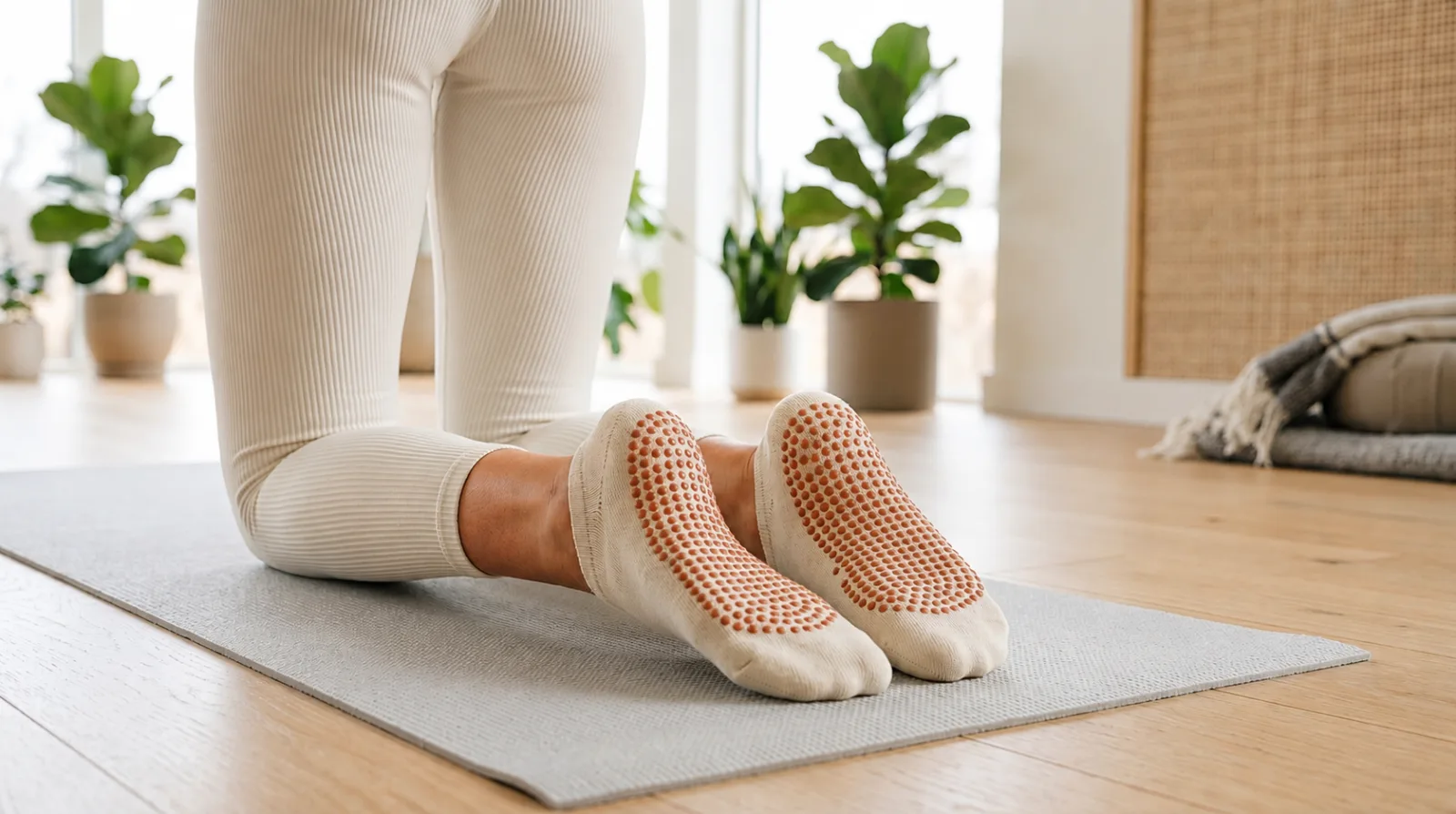
Grip sock types we manufacture
- No-show grip socks. The minimal studio cut, held by the grip itself plus a heel gripper. The style most yoga studios stock at the front desk.
- Ankle grip socks. The versatile middle of the range, worn for yoga, pilates, and barre alike. Usually the first SKU in a new grip line.
- Crew grip socks. More coverage and more branding canvas, popular in pilates and winter assortments, and the strongest format for knit-in patterns.
- Barre and dance styles. The same grip construction tuned for barre studios and dance fitness programs, where the sock is often mandatory kit and studios resell it at the counter.
- Logo-grip editions. Any of the above with the silicone grip printed in the shape of your logo, so the branding faces the mirror every time the wearer steps on the mat.
Grip application, in detail
The grip is what separates this category from every other sock, and it's applied as its own production step after knitting. What you specify:
- Pattern. Dot grids are the classic. Full-sole coverage grips hardest. Logo-shaped grip turns the sole into branding. Mixed layouts, denser under heel and forefoot, lighter mid-sole, are common on performance-leaning lines.
- Density and dot size. More silicone means more grip and a firmer feel underfoot. The right balance depends on whether the customer is holding poses or moving through them.
- Color. Grip silicone is colored to your palette: tonal for a clean look, contrast for visibility in class photos.
At the sample stage we verify adhesion and wash behavior before bulk, because grip that peels after a month is the category's most common failure and the fastest way to lose a studio account. Batch production then runs on the approved application settings.
Construction under the grip
A grip sole on a badly built sock still slides, because the foot moves inside the sock. The construction that prevents it: a close stretch knit that follows the foot, an arch band that stops rotation mid-pose, a non-slip cuff that keeps the opening anchored, and a seamless machine-linked toe so nothing rubs during long holds. Sizing runs snugger than casual socks by design, and the fit standard is documented in the tech pack like every other spec.
How grip socks are made
The sock itself is knit, closed, and boarded like any fine-gauge sock, the sequence our how socks are made guide walks through, and then passes to grip application, where the silicone pattern is printed onto the sole and cured. That extra step is why grip projects add a short stage to sampling: the grip is verified on the finished sock, not on paper. Inspection covers the usual sizing and pattern checks plus grip coverage and adhesion on every batch.
Materials that work on the mat
- Stretch cotton with elastane. The category default: breathable, soft, and close-fitting, with enough recovery to hold the shape class after class.
- Bamboo viscose blends. A smoother, cooler hand for premium and wellness-positioned lines. More on the fiber on our bamboo socks page.
- Moisture-wicking synthetics. The right call for hot yoga programs, where a cotton sock ends class saturated.
Every blend is specified by exact composition for your labelling, and yarn choice is one of the first things we settle at the quoting stage.
Studio, instructor, and brand programs
Grip socks have an unusual advantage: they're often required kit, which makes them the easiest retail product a studio will ever sell. The formats we produce for: studio counter programs (the studio's logo on sock and packaging, sold at the front desk), instructor and chain merch lines with coordinated colorways across locations, activewear brands adding grip as a SKU inside a wider movement range, and wellness DTC labels building gift sets. Packaging follows the sales channel: hangtags or printed sleeves for counter retail, boxes for gifting. The options are compared in our packaging guide.
MOQ, sampling, and ordering
The minimum is 50 pairs per design and size, which is what makes studio programs viable: one design in two sizes is a 100-pair order, a realistic first counter stock for a single studio. The counting logic is in our MOQ guide. Every project starts with a brief and a quote within 24 hours, includes a physical sample with the grip applied, and runs 3 to 6 weeks from approval to delivery. If you're starting from a mood board rather than a spec, our product development service takes it from idea to tech pack.
Why studios and brands knit grip socks with us
Grip socks fail at the details: silicone that peels, cuffs that slide, toe seams that rub in a long hold. Those details are exactly what a boutique factory controls, with grip verified at sampling, machine-linked toes in-house, and documented specs that keep a studio's third reorder identical to its first. The 50-pair minimum keeps entry easy, production runs on our own floor in Istanbul, and orders ship worldwide on DAP or FOB terms.